> ## Documentation Index
> Fetch the complete documentation index at: https://docs.tablepro.app/llms.txt
> Use this file to discover all available pages before exploring further.
# Data Files
> Open CSV, TSV, JSON and Excel files in their own window, then filter, clean up, save or export them without importing anything
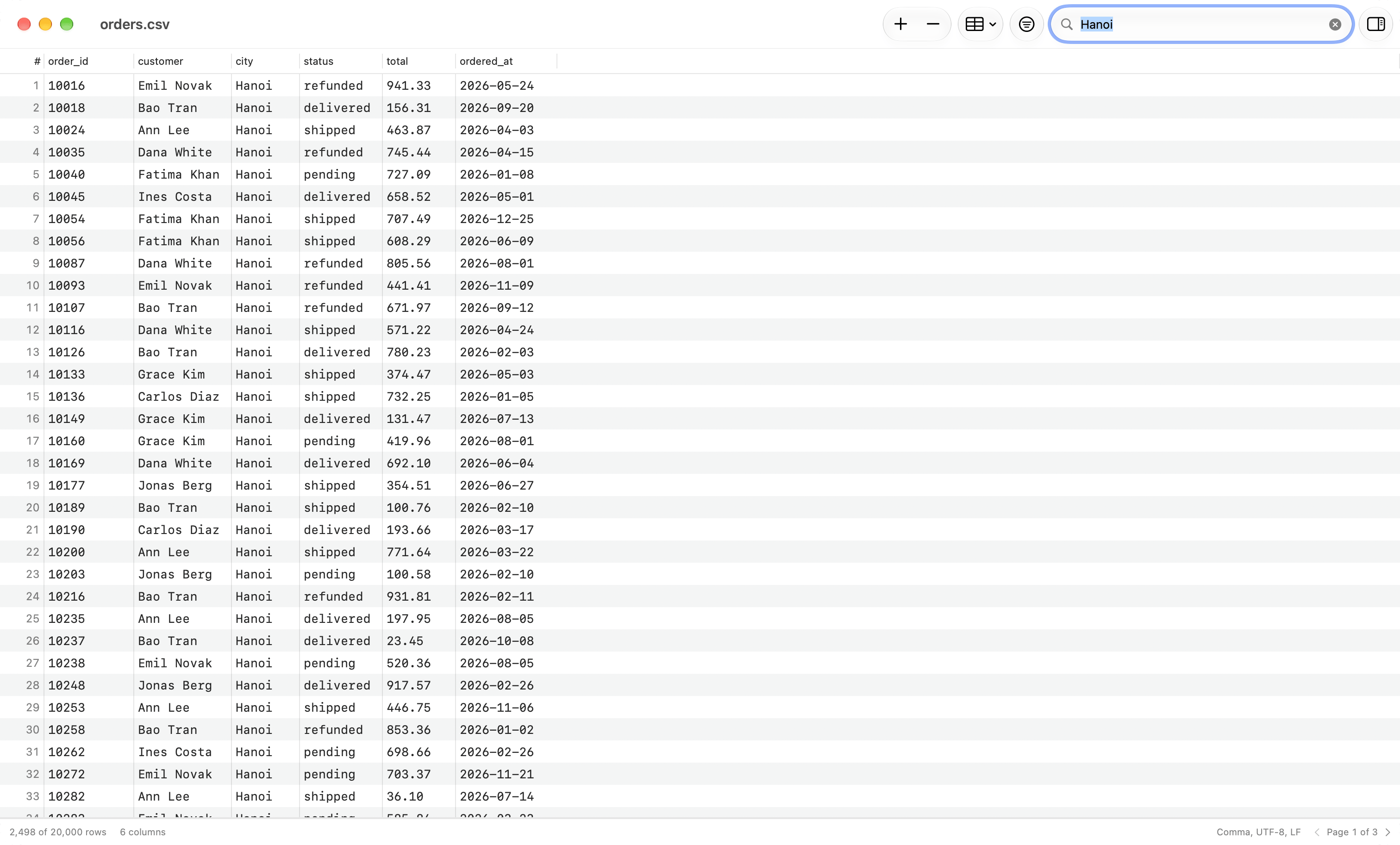
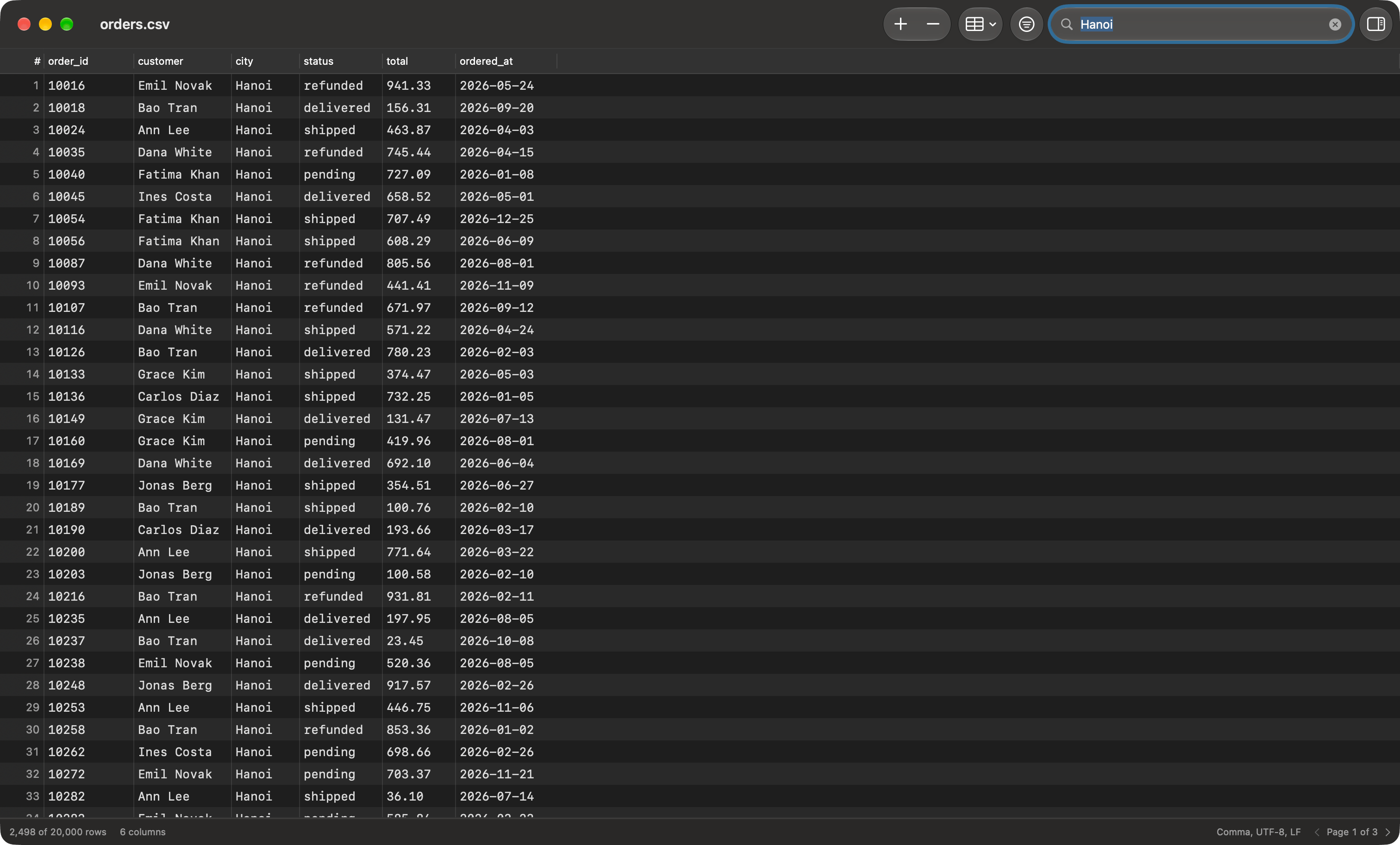
A spreadsheet export gets the same tools as a table, minus the database: the data grid, the table filter bar, a find bar and Row Details, all working on the file itself in a window of its own. Nothing is imported and no connection is needed.
 ## Files that open
| File | Opens | Save writes |
| ------------------------------------ | ---------------------------------------------- | --------------------------------------------------------------------------- |
| `.csv`, `.tsv`, `.psv` | Editable | The same format, with the detected delimiter, encoding, line ending and BOM |
| `.txt`, `.dat` | Editable, delimiter detected from the contents | The same format |
| `.json` (an array of objects) | Editable, one column per key | JSON |
| `.jsonl`, `.ndjson` | Editable, one object per line | JSON Lines |
| `.xlsx` | Read-only, one tab per sheet | Save As a CSV, TSV or pipe-separated file |
| `.csv.gz` and other compressed files | Read-only | Save As an uncompressed file |
Open a file from Finder with a double-click or **Open With > TablePro**, drag it onto the Dock icon, or choose **File > Open File…** (`Cmd+O`). `.json` and `.ndjson` files open here even when the DuckDB driver is installed; `.parquet` files still open as a DuckDB connection.
The window works on a private copy of the file taken when it opens, so another app writing the file cannot change what you are looking at. When that happens, the window reloads if you have no unsaved edits, and asks whether to reload or keep your changes if you do.
## How a delimited file is read
| Setting | How it is chosen |
| ------------ | ------------------------------------------------------------------------------------------------------------------------------------------------------ |
| Encoding | A byte order mark picks UTF-8, UTF-16 LE or UTF-16 BE. Without one, the first 256 KB decide: valid UTF-8 reads as UTF-8, anything else as Windows-1252 |
| Delimiter | Comma, tab, semicolon or pipe, whichever appears most often outside quotes in the first 64 KB. `.tsv` always uses tab and `.psv` always uses pipe |
| Line ending | CRLF, LF or CR, whichever comes first outside quotes |
| Header row | Row one is the header when at least half of its cells are text rather than numbers |
| Column types | Integer, decimal, boolean, date or text, from the first 200 non-blank values in each column |
Two columns with the same header, or an empty one, get unique names such as `amount (2)` and `Column 3`. A row with more fields than the first row widens the table, and the status bar counts how many rows differ.
When a guess is wrong, choose **Edit > Data > File Properties…** to set the delimiter, quote, escape character, encoding, line ending and header row by hand, then click **Reload**. To flip only the header, choose **Edit > Data > Switch First Row Between Header and Data** (`Cmd+Shift+H`). **Change Type** on a column header overrides an inferred type, which changes how the column sorts, filters and appears in statistics, never what is written to disk.
## Filter, search and sort
`Cmd+Shift+F` shows the filter bar. It is the filter bar a table tab uses, run over the file instead of a database: all 18 operators, **Match all** or **Match any**, a checkbox per row, **Match Case**, and saved presets. It has no raw SQL row. See [Filtering](/features/filtering) for how each operator reads a value.
A comparison is numeric whenever the cell and the value both read as numbers, so `> 50` keeps `100` and drops `9`. Anything else compares as text. A CSV cell is never NULL, so **is NULL** matches nothing and **is empty** matches blank cells. In JSON, a `null` value and a missing key are both NULL.
Right-click a cell and choose **Filter** to add a condition built from its value. The **Search All Columns** field in the toolbar keeps the rows where any column contains the text, ignoring case and accents, and works alongside the filter bar.
Click a column header to sort by it, and `Shift`-click another header to add a tie-breaker. Numbers sort by value, text sorts naturally so `Item 2` comes before `Item 10`, and blank cells always sort last.
Changing a filter, the search or the sort goes back to page 1.
## Find and replace
`Cmd+F` opens the find bar and `Cmd+Option+F` opens it with a replace field. It searches every row in the file, not the current page, and counts the matches as `3 of 1,204`. `Return` or `Cmd+G` moves to the next match and reveals it; `Cmd+Shift+G` goes back.
The options menu beside the field turns on **Match Case**, **Whole Words** and **Regular Expression**. With a regular expression, `$1` in the replacement inserts the first capture group.
**Replace All** changes every match in one step, so one `Cmd+Z` puts all of them back. To search one column, right-click its header and choose **Replace in Column…**. Hidden columns are not searched.
## Column statistics
## Files that open
| File | Opens | Save writes |
| ------------------------------------ | ---------------------------------------------- | --------------------------------------------------------------------------- |
| `.csv`, `.tsv`, `.psv` | Editable | The same format, with the detected delimiter, encoding, line ending and BOM |
| `.txt`, `.dat` | Editable, delimiter detected from the contents | The same format |
| `.json` (an array of objects) | Editable, one column per key | JSON |
| `.jsonl`, `.ndjson` | Editable, one object per line | JSON Lines |
| `.xlsx` | Read-only, one tab per sheet | Save As a CSV, TSV or pipe-separated file |
| `.csv.gz` and other compressed files | Read-only | Save As an uncompressed file |
Open a file from Finder with a double-click or **Open With > TablePro**, drag it onto the Dock icon, or choose **File > Open File…** (`Cmd+O`). `.json` and `.ndjson` files open here even when the DuckDB driver is installed; `.parquet` files still open as a DuckDB connection.
The window works on a private copy of the file taken when it opens, so another app writing the file cannot change what you are looking at. When that happens, the window reloads if you have no unsaved edits, and asks whether to reload or keep your changes if you do.
## How a delimited file is read
| Setting | How it is chosen |
| ------------ | ------------------------------------------------------------------------------------------------------------------------------------------------------ |
| Encoding | A byte order mark picks UTF-8, UTF-16 LE or UTF-16 BE. Without one, the first 256 KB decide: valid UTF-8 reads as UTF-8, anything else as Windows-1252 |
| Delimiter | Comma, tab, semicolon or pipe, whichever appears most often outside quotes in the first 64 KB. `.tsv` always uses tab and `.psv` always uses pipe |
| Line ending | CRLF, LF or CR, whichever comes first outside quotes |
| Header row | Row one is the header when at least half of its cells are text rather than numbers |
| Column types | Integer, decimal, boolean, date or text, from the first 200 non-blank values in each column |
Two columns with the same header, or an empty one, get unique names such as `amount (2)` and `Column 3`. A row with more fields than the first row widens the table, and the status bar counts how many rows differ.
When a guess is wrong, choose **Edit > Data > File Properties…** to set the delimiter, quote, escape character, encoding, line ending and header row by hand, then click **Reload**. To flip only the header, choose **Edit > Data > Switch First Row Between Header and Data** (`Cmd+Shift+H`). **Change Type** on a column header overrides an inferred type, which changes how the column sorts, filters and appears in statistics, never what is written to disk.
## Filter, search and sort
`Cmd+Shift+F` shows the filter bar. It is the filter bar a table tab uses, run over the file instead of a database: all 18 operators, **Match all** or **Match any**, a checkbox per row, **Match Case**, and saved presets. It has no raw SQL row. See [Filtering](/features/filtering) for how each operator reads a value.
A comparison is numeric whenever the cell and the value both read as numbers, so `> 50` keeps `100` and drops `9`. Anything else compares as text. A CSV cell is never NULL, so **is NULL** matches nothing and **is empty** matches blank cells. In JSON, a `null` value and a missing key are both NULL.
Right-click a cell and choose **Filter** to add a condition built from its value. The **Search All Columns** field in the toolbar keeps the rows where any column contains the text, ignoring case and accents, and works alongside the filter bar.
Click a column header to sort by it, and `Shift`-click another header to add a tie-breaker. Numbers sort by value, text sorts naturally so `Item 2` comes before `Item 10`, and blank cells always sort last.
Changing a filter, the search or the sort goes back to page 1.
## Find and replace
`Cmd+F` opens the find bar and `Cmd+Option+F` opens it with a replace field. It searches every row in the file, not the current page, and counts the matches as `3 of 1,204`. `Return` or `Cmd+G` moves to the next match and reveals it; `Cmd+Shift+G` goes back.
The options menu beside the field turns on **Match Case**, **Whole Words** and **Regular Expression**. With a regular expression, `$1` in the replacement inserts the first capture group.
**Replace All** changes every match in one step, so one `Cmd+Z` puts all of them back. To search one column, right-click its header and choose **Replace in Column…**. Hidden columns are not searched.
## Column statistics
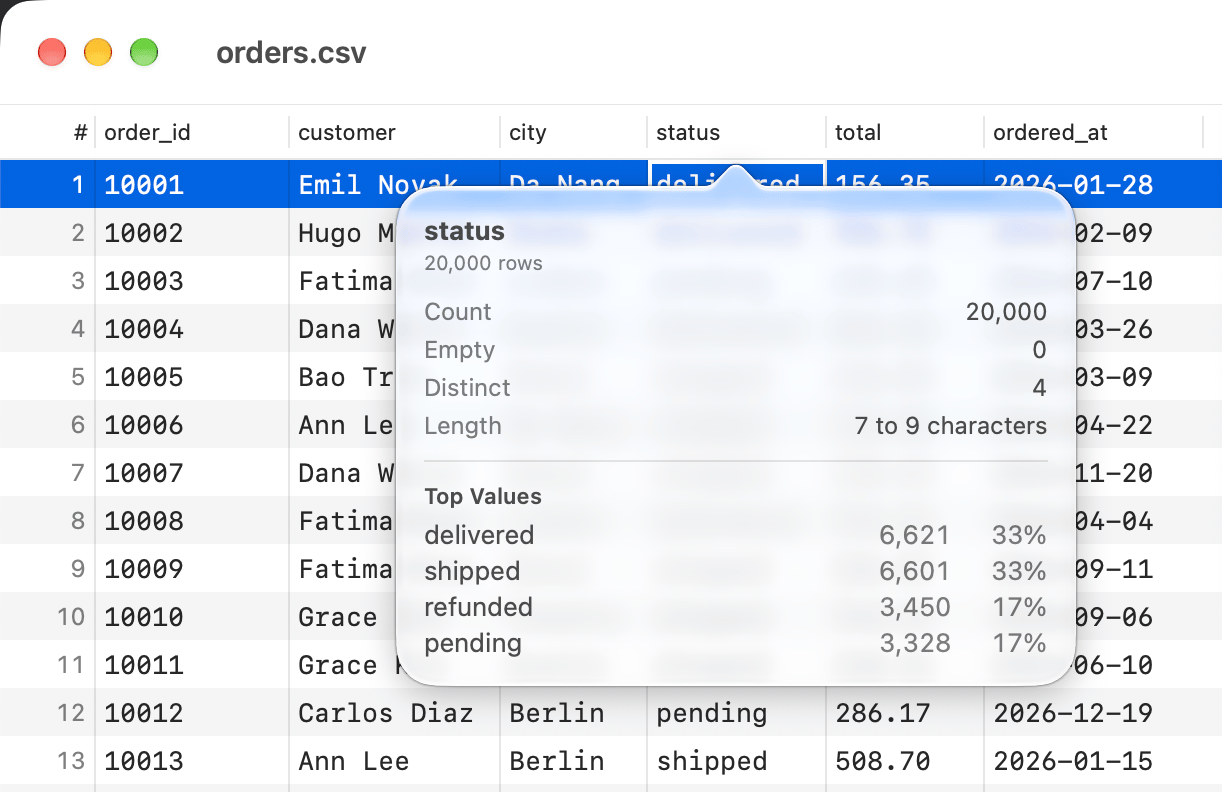
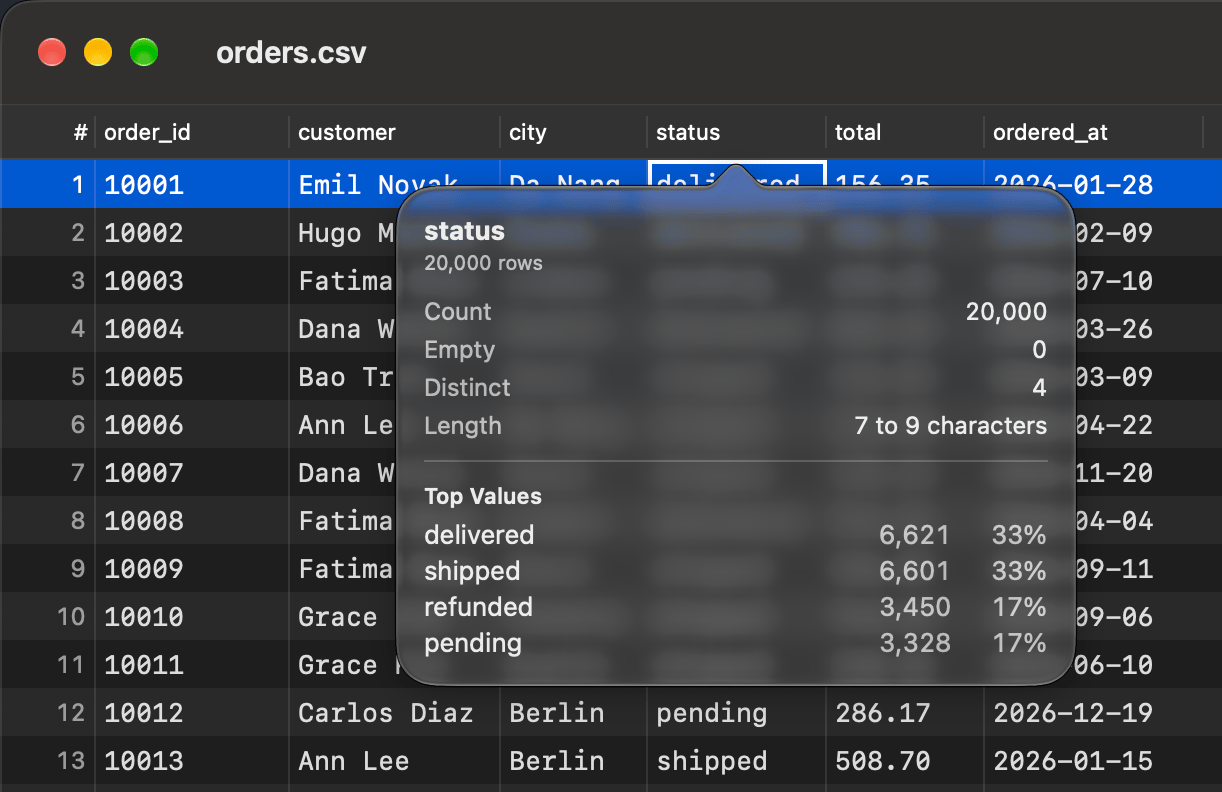 Right-click a column header and choose **Column Statistics…**, or select a cell and choose **Edit > Data > Column Statistics…**. The popover shows:
* the row count, empty cells and distinct values
* minimum, maximum, sum, mean and median for a number column, plus how many cells are not numbers
* the earliest and latest value for a date column
* the shortest and longest value, in characters
* the most common values with their counts, the first ten until you click **Show All**
Click a value in the list to filter the file to it.
## Row details
`Cmd+Option+I` opens Row Details beside the grid. It shows the selected row as a list of fields, each editable in place. An edit is committed when you stop typing, and `Cmd+Z` undoes it like any other edit.
## Edit rows and columns
Double-click a cell, or select it and press `Return`, to edit it. `Cmd+Shift+N` adds a row at the end; **Insert Row Above** and **Insert Row Below** are on a row's context menu. Select rows and press `Cmd+Delete` to delete them.
`Cmd+C` copies the selected rows as tab-separated text. With a cell selected, `Cmd+V` pastes a tab-separated block into the cells from there rightward and down. With no cell selected, it adds the lines as new rows, and a block wider than the table adds the columns it needs.
Right-click a column header, or use the **Columns** menu in the toolbar, to rename, insert, split, merge, retype or delete columns. **Split Column…** splits every value at a separator or a regular expression, and **Merge Columns…** joins a column with the one to its right.
## Clean up data
These commands are on **Edit > Data** and on the column header's context menu. With a whole column selected they change every visible row; with cells selected they change only those cells. Each one is a single undo step.
| Command | Does |
| -------------------------- | ------------------------------------------------------------------------------------------------------------------------------- |
| **Fill Down** | Copies the first targeted cell's value into the others |
| **Set Cells to Value…** | Writes one value into every targeted cell |
| **Trim Whitespace** | Removes spaces, tabs and line breaks at the start and end of each value |
| **Change Case** | Converts to UPPERCASE, lowercase or Title Case |
| **Replace in Column…** | Opens the find bar limited to that column |
| **Remove Duplicate Rows…** | Keeps the first of each group of rows that match on the columns you choose, optionally ignoring case and surrounding whitespace |
Rows hidden by a filter or search are left alone by every command here.
## Large files
A file opens without being read into memory: the rows are indexed, and cells are read when they are shown, filtered or sorted. Rows appear a page at a time, at the **Default page size** from **Settings > Data**, and the status bar has the page controls.
Filtering, sorting, searching, statistics and bulk edits run in the background. When one takes longer than a moment, the status bar shows its progress and a **Cancel** button; a cancelled bulk edit changes nothing. Editing is paused while a bulk edit runs.
On a 12-core Apple silicon Mac, a 1 GB CSV with 6.9 million rows opens in about 0.4 s, filters in about 0.3 s, and searches every column or sorts in about a second.
## JSON files
Each object is a row and each key is a column. A key missing from an object reads as NULL, the same as `null`, and nested objects and arrays appear as their JSON text.
An edited value keeps its JSON type. Type `42` over a number and it stays a number; type text over it and it becomes a string. A value typed into an empty cell takes the column's type, so a number typed into a number column is saved as a number. Text typed over an object or array that is not valid JSON is saved as a string.
Save rewrites only the objects you changed, and only the values in them you edited, so formatting, key order and number spellings elsewhere are kept exactly. Renaming or deleting a column renames or removes that key in every object.
## Excel workbooks
Every sheet in an `.xlsx` gets a tab under the grid; hidden sheets are marked as hidden. A sheet is read when you first open its tab. Dates are shown as ISO dates and times, and numbers keep the digits stored in the file.
A workbook is read-only. To keep a sheet, choose **File > Save As** and pick CSV, or export it.
## Save and export
`Cmd+S` writes the file back in its own format. Rows you did not touch are copied byte for byte, so a large file with a handful of edits saves quickly and differs from the original only where you changed it. If a value holds a character the file's encoding cannot store, the save stops and names the row and column. Choose **File > Save As** and set **Text Encoding** to UTF-8 to keep it; later saves keep the new encoding.
**File > Save As** (`Cmd+Shift+S`) writes a delimited file as CSV, TSV or pipe-separated text, and a JSON file as JSON, JSON Lines, CSV or TSV.
To write another format, choose **File > Export > Export Results…**, or right-click the grid and choose **Export Results…**. The export dialog offers every installed export format that works without a database, including CSV, JSON, SQL, XLSX, Markdown and HTML, and exports all rows, the rows passing the current filter, or the selected rows.
### Import into a table
To load the file into a database, open a connection first, then choose **Edit > Data > Import into Table…** and pick the connection. Its import sheet opens with the rows of this file, unsaved edits included, and maps them onto a table the usual way. Read-only connections are not offered. See [Import and Export](/features/import-export).
Right-click a column header and choose **Column Statistics…**, or select a cell and choose **Edit > Data > Column Statistics…**. The popover shows:
* the row count, empty cells and distinct values
* minimum, maximum, sum, mean and median for a number column, plus how many cells are not numbers
* the earliest and latest value for a date column
* the shortest and longest value, in characters
* the most common values with their counts, the first ten until you click **Show All**
Click a value in the list to filter the file to it.
## Row details
`Cmd+Option+I` opens Row Details beside the grid. It shows the selected row as a list of fields, each editable in place. An edit is committed when you stop typing, and `Cmd+Z` undoes it like any other edit.
## Edit rows and columns
Double-click a cell, or select it and press `Return`, to edit it. `Cmd+Shift+N` adds a row at the end; **Insert Row Above** and **Insert Row Below** are on a row's context menu. Select rows and press `Cmd+Delete` to delete them.
`Cmd+C` copies the selected rows as tab-separated text. With a cell selected, `Cmd+V` pastes a tab-separated block into the cells from there rightward and down. With no cell selected, it adds the lines as new rows, and a block wider than the table adds the columns it needs.
Right-click a column header, or use the **Columns** menu in the toolbar, to rename, insert, split, merge, retype or delete columns. **Split Column…** splits every value at a separator or a regular expression, and **Merge Columns…** joins a column with the one to its right.
## Clean up data
These commands are on **Edit > Data** and on the column header's context menu. With a whole column selected they change every visible row; with cells selected they change only those cells. Each one is a single undo step.
| Command | Does |
| -------------------------- | ------------------------------------------------------------------------------------------------------------------------------- |
| **Fill Down** | Copies the first targeted cell's value into the others |
| **Set Cells to Value…** | Writes one value into every targeted cell |
| **Trim Whitespace** | Removes spaces, tabs and line breaks at the start and end of each value |
| **Change Case** | Converts to UPPERCASE, lowercase or Title Case |
| **Replace in Column…** | Opens the find bar limited to that column |
| **Remove Duplicate Rows…** | Keeps the first of each group of rows that match on the columns you choose, optionally ignoring case and surrounding whitespace |
Rows hidden by a filter or search are left alone by every command here.
## Large files
A file opens without being read into memory: the rows are indexed, and cells are read when they are shown, filtered or sorted. Rows appear a page at a time, at the **Default page size** from **Settings > Data**, and the status bar has the page controls.
Filtering, sorting, searching, statistics and bulk edits run in the background. When one takes longer than a moment, the status bar shows its progress and a **Cancel** button; a cancelled bulk edit changes nothing. Editing is paused while a bulk edit runs.
On a 12-core Apple silicon Mac, a 1 GB CSV with 6.9 million rows opens in about 0.4 s, filters in about 0.3 s, and searches every column or sorts in about a second.
## JSON files
Each object is a row and each key is a column. A key missing from an object reads as NULL, the same as `null`, and nested objects and arrays appear as their JSON text.
An edited value keeps its JSON type. Type `42` over a number and it stays a number; type text over it and it becomes a string. A value typed into an empty cell takes the column's type, so a number typed into a number column is saved as a number. Text typed over an object or array that is not valid JSON is saved as a string.
Save rewrites only the objects you changed, and only the values in them you edited, so formatting, key order and number spellings elsewhere are kept exactly. Renaming or deleting a column renames or removes that key in every object.
## Excel workbooks
Every sheet in an `.xlsx` gets a tab under the grid; hidden sheets are marked as hidden. A sheet is read when you first open its tab. Dates are shown as ISO dates and times, and numbers keep the digits stored in the file.
A workbook is read-only. To keep a sheet, choose **File > Save As** and pick CSV, or export it.
## Save and export
`Cmd+S` writes the file back in its own format. Rows you did not touch are copied byte for byte, so a large file with a handful of edits saves quickly and differs from the original only where you changed it. If a value holds a character the file's encoding cannot store, the save stops and names the row and column. Choose **File > Save As** and set **Text Encoding** to UTF-8 to keep it; later saves keep the new encoding.
**File > Save As** (`Cmd+Shift+S`) writes a delimited file as CSV, TSV or pipe-separated text, and a JSON file as JSON, JSON Lines, CSV or TSV.
To write another format, choose **File > Export > Export Results…**, or right-click the grid and choose **Export Results…**. The export dialog offers every installed export format that works without a database, including CSV, JSON, SQL, XLSX, Markdown and HTML, and exports all rows, the rows passing the current filter, or the selected rows.
### Import into a table
To load the file into a database, open a connection first, then choose **Edit > Data > Import into Table…** and pick the connection. Its import sheet opens with the rows of this file, unsaved edits included, and maps them onto a table the usual way. Read-only connections are not offered. See [Import and Export](/features/import-export).